The Two-Account Rule: Why Keeping Bills and Daily Spending Together is a Financial Trap
Most people manage their personal finances using a single bank account. Their salary arrives there, their debit card is linked to it, their transfers leave from it, and their annual rent sits inside it.
On paper, keeping everything in one place seems simple and organized. In reality, it is one of the most stressful ways to manage money.
When your bill money, savings, and weekend lifestyle spending all swim in the same pool, every transaction requires mental math. You look at your banking app, see ₦450,000 or $1,200, and your brain tells you that you are doing well. But buried inside that balance is next month's utility bill, car maintenance money, and half of your upcoming rent.
You swipe your card thinking you have plenty of room to spare. Two weeks later, a scheduled debit bounces or you find yourself borrowing to bridge the gap.
The Cognitive Load of One Account
Every time you buy a coffee, book a ride, or pay for lunch, you shouldn't have to calculate:
- How much of this balance belongs to next month's landlord?
- What subscriptions are renewing between now and the 28th?
- Can I actually afford this weekend outing without touching my tax money?
Behavioral economists, led by Nobel Memorial Prize laureate Dr. Richard Thaler in his seminal research on Mental Accounting Theory, established that human beings naturally assign different subjective values to money based on source and intent. However, traditional commercial banking apps strip away this mental architecture by presenting one single aggregate number.
When you see a single large balance, your brain defaults to an illusion of surplus wealth, a cognitive distortion explored in The Friday-After-Payday Paradox. Nobody has the willpower to calculate pending liabilities multiple times a day under cognitive fatigue. Eventually, you stop calculating and spend blindly until the account alerts you that funds are depleted.
The Two-Account Architecture
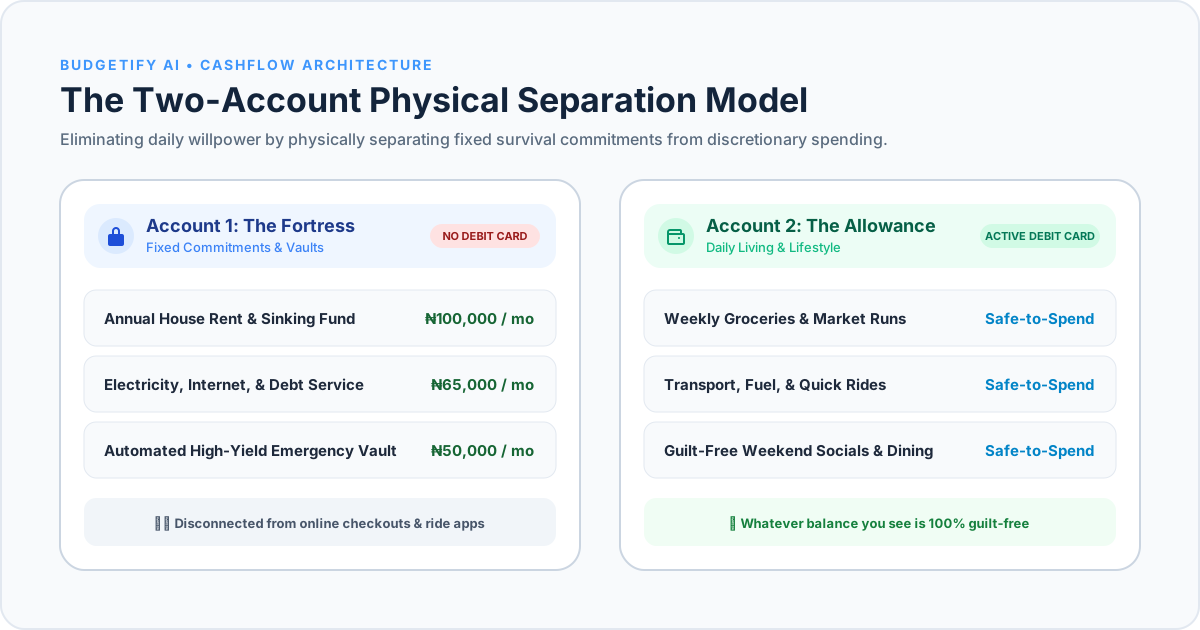
The solution is deceptively simple: create a physical separation between your commitments and your lifestyle.
The Two-Account Cashflow Engine
Eliminating mental math by keeping survival bills and daily spending apart.
Primary Inflow
Paycheck / Client Inflows
- • Rent, mortgage, and utilities
- • School fees and annual debt service
- • Automated emergency buffer
- • Invisible to daily swipe temptations
- • Groceries and dining out
- • Fuel, transport, and ride hailing
- • Guilt-free personal entertainment
- • What you see is 100% safe to spend
Account 1: The Fortress (Bills and Commitments)
This account receives your salary or client revenue. It is dedicated strictly to fixed obligations: rent, electricity, internet, debt payments, and automated savings buffers. If you run a business or freelance practice, this framework works alongside Separating Personal and Business Cashflow to prevent operational capital from bleeding into household costs.
Money enters this account, pays your bills through scheduled automated transfers, accumulates reserves using The Sinking Fund Blueprint, and stays untouched.
Account 2: The Allowance (Daily Spending)
This is your everyday lifestyle account. Once your obligations, baseline emergency reserves from The Starter Buffer, and fixed savings are accounted for in Account 1, a calculated weekly or bi-weekly allowance is transferred here.
This account does have a debit card. You can use it freely for groceries, drinks with friends, fuel, and shopping.
The beauty of this setup is total clarity. If Account 2 has ₦25,000 left on Wednesday, you know with absolute certainty that you have exactly ₦25,000 left for discretionary spending until your next transfer. You do not need to check spreadsheets or worry about rent, because rent is already safe in Account 1.
Mental Math vs. Two-Account Architecture
Single Account (Mental Math)
Two-Account Engine (Budgetify AI)
Why This Works When Budgeting Apps Fail
Traditional budgeting requires you to categorize twenty different expense buckets every week: groceries, transport, dining, hygiene, entertainment. It feels like taking on a second job as a personal bookkeeper.
The two-account system reduces all those micro-decisions down to one simple question: What is in Account 2 right now?
If the money is there, you can spend it guilt-free. If it runs dry, you wait until the next allowance transfer. Your bills remain paid, your savings stay intact, and your peace of mind is protected.
Frequently asked questions
The two-account rule physically separates your finances into two distinct accounts: a cardless Fortress Account dedicated strictly to fixed commitments, rent, utilities, and automated savings, and an Allowance Account with a linked debit card for daily discretionary spending.