The December Trap: How to Enjoy the Holidays Without Starting January in Debt
There is a running cultural joke that January has seventy-four days.
People get paid their December salary early (often around December 18th or 20th), spend wildly for two weeks of parties, gifts, family gatherings, and holiday festivities, and then spend the next six weeks waiting for the January 31st paycheck in total financial agony.
In West Africa, this phenomenon has a famous name: "Detty December." In Europe and North America, it is called the Holiday Hangover.
Whatever you call it, the underlying mechanics are identical: the emotional high of the holiday season causes people to spend thirty days of salary in ten days of celebration.
The problem is not that people celebrate. Life is meant to be celebrated, and coming together with family, friends, and loved ones at the close of an exhausting year is one of the greatest joys of being human.
The problem is that people finance December festivities using money that actually belongs to January's survival.
The January Reality Check
Consider what arrives on your doorstep in the first two weeks of January:
- First-term or second-term school fees and books
- Annual house rent renewals
- January electricity, water, and waste bills
- Four full weeks of daily transport and groceries before the next paycheck arrives
If your December salary arrives on December 20th, and your next payday is January 31st, that is forty-two days between paychecks, not thirty.
When you spend eighty percent of your salary during the five-day window between Christmas Eve and New Year's Day, you are setting a trap for your future self, an extreme escalation of The Friday-After-Payday Paradox.
Why December Payday Creates A 42-Day Crisis
How forty-two days of bills get compressed into a ten-day spending spree.
Full salary + potential bonus paid early by employers
- Rapid outflows: concerts, outings, clothes
- Illusion of abundant wealth
- 80% of monthly capital burnt in 10 days
- School fees, annual rent, electricity due
- Checking accounts drained to near zero
- Six long weeks of financial anxiety
The Three-Move December Defense Playbook
You do not need to sit at home in the dark while your friends celebrate. You can attend the concerts, host the dinners, and buy thoughtful gifts for your family. Similar to the principles in The Black Friday Defense Playbook, defense requires pre-commitment.
You just need to execute three defensive moves before December 1st:
Move 1: The January Ring-Fence (Do This First)
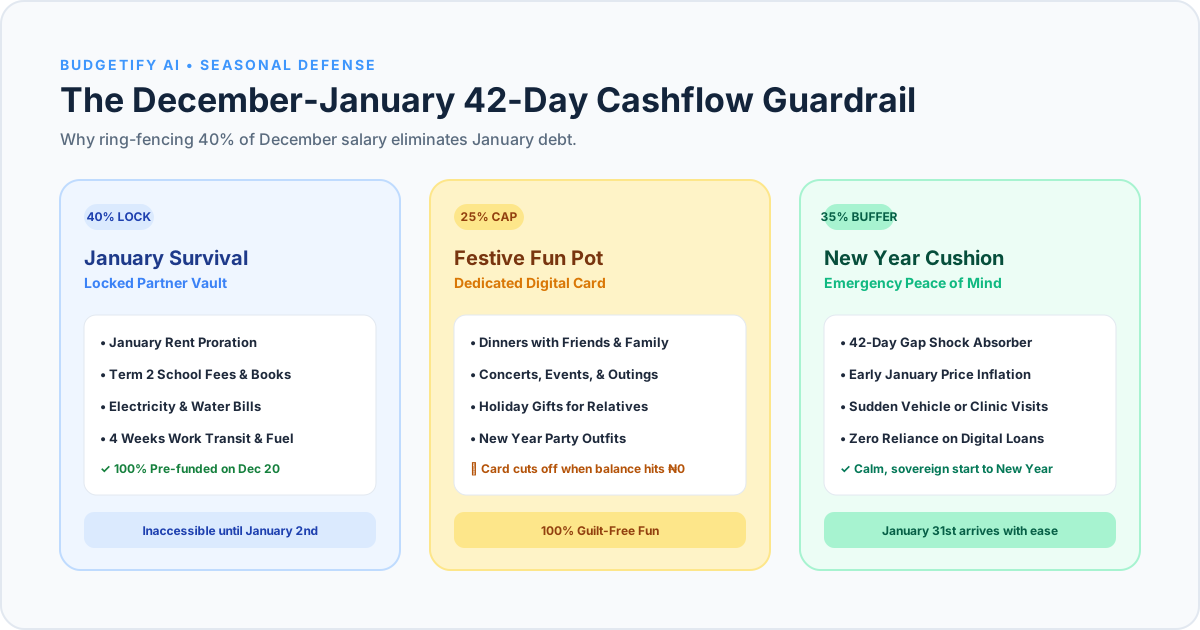
The moment your December income or bonus arrives, pretend that forty percent of it does not exist.
Calculate your January fixed survival baseline: January rent portion, school fees, groceries, and transport to work.
Move that money immediately into an isolated, protected partner vault using The Two-Account Rule. Do not leave it in your primary checking account. If it sits in your checking account on December 24th, you will convince yourself that you can spend it and replace it later. Lock it away so it is completely invisible during festive shopping.
December vs. January Survival Splitter
Calculate your exact Safe Festive Cap so you wake up on January 2nd fully funded.
Money ring-fenced immediately before holiday celebrations begin.
₦360,000
Locked & invisible in Budgetify AI partner vault until Jan 2nd.
₦280,000
Safe to spend on gifts, dinners, and events. When it hits zero, stop.
₦160,000
Guarantees you cross the 42-day gap to Jan 31st with zero debt.
Move 2: Create a Dedicated Festive Cash Pot
Decide the exact total amount you can comfortably spend on holiday entertainment, travel, and gifts without touching your January baseline. If you planned ahead using The Sinking Fund Blueprint, this fund is already waiting for you without stressing your monthly income.
Transfer that entire sum to a secondary spending account or a separate digital card.
This is your official Festive Budget:
- Drinks with colleagues? Comes from the Festive Pot.
- Holiday gifts for nephews and cousins? Comes from the Festive Pot.
- Concert tickets and road trips? Comes from the Festive Pot.
When that specific pot reaches zero, your holiday spending is officially finished. You can still attend free gatherings, visit friends, and enjoy community, but your card stays in your wallet.
You have spent ₦120,000 of your ₦150,000 Festive Pot. You have ₦30,000 remaining for the next 4 days before celebrations close.
Move 3: Beware of "Social Inflation"
December is the peak season for performative spending. People hire expensive rental cars, pop overpriced bottles at lounges, and buy designer outfits just to post photos on social media.
Half of the people popping champagne next to you in December will be secretly texting friends on January 5th begging for emergency loans to buy groceries.
Do not trade thirty days of quiet financial peace for three hours of applause from strangers who do not care about your future.
December Spending Strategy: Two Realities
The Reckless December
The Protected December (Budgetify AI)
Enter the New Year with True Confidence
There is no feeling quite like waking up on January 2nd with zero debt, your rent already safe, your bills fully funded, and a healthy balance growing in your automated savings vaults.
While everyone else spends January stressed and regretful, you start the new year with momentum, clarity, and true financial power.
Celebrate your holidays. Love your people. But protect your future first.
Frequently asked questions
December paychecks are traditionally disbursed early around December 18th to 20th, whereas January salaries do not arrive until January 31st. This creates an unmonitored forty-two-day liquidity gap. Concentrating spending in late December leaves households stranded for six weeks.