How to Budget When You Don’t Have a Fixed Salary: A Guide for Freelancers and Solopreneurs
Standard financial advice is written almost entirely for people with predictable salaries. It assumes you get paid on the 25th or 28th of every month, your income is constant, and your only job is dividing that exact number across thirty days.
For freelancers, agency owners, consultants, and independent creators, this advice is completely detached from reality.
In June, you close three big projects and pull in ₦1,800,000 ($2,500). You feel invincible. In July, two client payments get delayed, a contract pauses, and your total revenue is ₦250,000 ($350).
When your income fluctuates wildly from month to month, trying to follow a rigid monthly budget feels like trying to sail a ship through a storm with a paper compass. During high months you overspend because the account is flush, and during lean months you panic and dip into credit cards or debt.
Here is how you make an erratic income behave like a stable, reliable salary.
Step 1: Calculate Your Survival Baseline
Before you can manage variable cashflow, you must know your absolute floor. Your survival baseline is the minimum monthly amount required to keep your life functional:
- Basic rent and housing costs
- Fundamental groceries and clean water
- Electricity, internet, and essential phone connectivity
- Minimum debt payments and essential insurance
Do not include vacations, new clothes, or high-end dining out here. This is your pure break-even number. Let us assume your survival baseline is ₦350,000 per month. If you are starting from zero savings, begin by locking in The Starter Buffer before expanding into larger reserves.
Step 2: The Holding Tank Model
The single biggest mistake independent earners make is depositing client payments straight into their daily spending account. When a ₦1,000,000 invoice clears into the same checking account you use for lunch, you feel rich. You spend accordingly, forgetting that August might bring zero client payments.
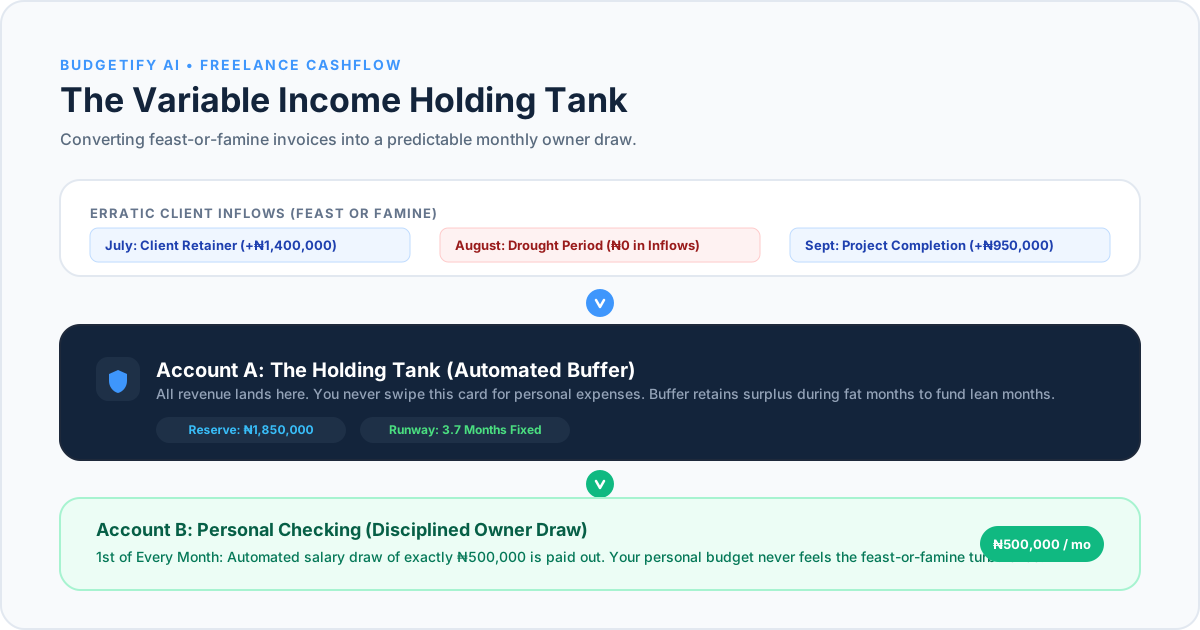
Instead, implement The Two-Account Rule specifically tailored for solo operators: separate your business revenue from your personal consumption:
The Variable Income Holding Tank
How freelancers convert feast-or-famine invoices into a steady monthly salary
Unpredictable Invoices
Variable spikes: ₦1.5m in July, ₦0 in August
The Holding Tank
Receives all client payments; accumulates reserves
Fixed Artificial Salary
Automated draw transferred every 1st of the month
How the Holding Tank Operates:
- All client payments, retainer fees, and freelance earnings land in Account A (The Holding Tank).
- You never use Account A's debit card for personal life. You do not touch it for groceries, weekend outings, or online shopping. For full separation guidelines, review Separating Personal and Business Cashflow.
- On the first of every month (or every Friday), Account A pays you a fixed Artificial Salary into Account B (your everyday personal account).
If your survival baseline is ₦350,000 and your comfortable lifestyle requires ₦500,000, Account A transfers exactly ₦500,000 to you every month. Nothing more, nothing less.
What Happens During Monster Months?
Suppose in September a major client pays you ₦2,200,000.
In the old, chaotic system, you would have treated yourself to expensive gadgets and luxury hotels, burning through the cash by October.
Under the Holding Tank model:
- The ₦2,200,000 lands in the Holding Tank.
- It pays you your standard ₦500,000 salary for the month.
- The remaining ₦1,700,000 stays in the Holding Tank.
That surplus is not spending money; it is your Revenue Cushion. It sits in a high-yield partner vault, earning interest, waiting to fund your ₦500,000 salary during the quiet months of November or January when corporate accounts freeze vendor disbursements, a trap analyzed in The December Holiday Trap.
Financial Peace of Mind as a Creative
The goal of freelancing and self-employment is freedom. But freedom without financial structure quickly turns into 24/7 anxiety.
When you implement the Holding Tank model, you take the emotional volatility out of freelance life. Clients can delay invoices, projects can shift timelines, and contracts can renew slowly, but your personal life remains steady, calm, and fully funded.
Frequently asked questions
Freelancers manage variable income using the Holding Tank Model. All client retainers and project fees land in a business holding vault. The freelancer then pays themselves a consistent, predetermined artificial salary on fixed calendar dates into a separate personal spending account, leaving surplus cash in the tank to cushion quiet months.